
Drink and Drug Driving

- Drink and Drug Driving
Going to Court For Drink and Drug Driving?
100+ 5 Star Google Reviews
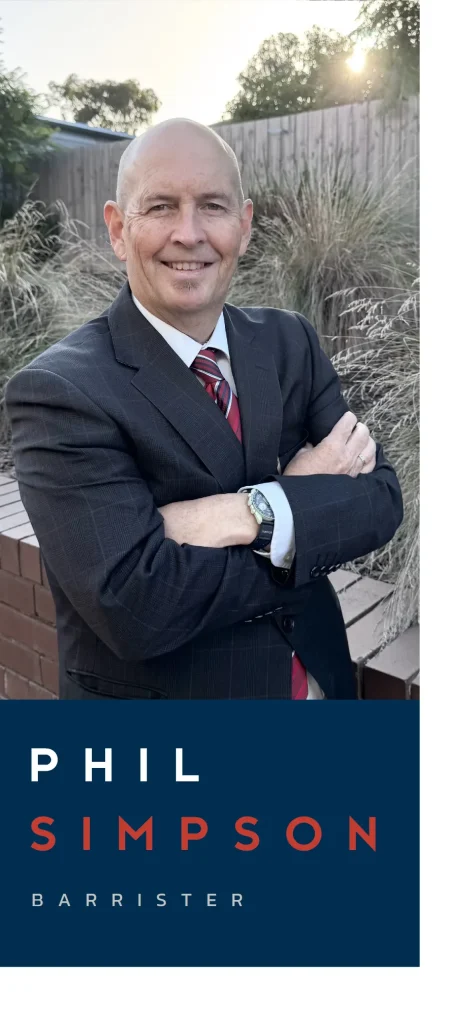
Phil Simpson Barrister
Phil Simpson has been a Barrister at the Victorian Bar for over 25 years. During this time, he has appeared for thousands of clients in a wide variety of cases. Phil spends most of his time appearing in the Magistrates’ Court for people who have been charged by the Police with all manner of driving offences.
Phil has a thorough knowledge of the law and is also pragmatic. He is known for his down-to-earth approach. He works hard for his clients and he is determined to get each of his clients the best possible outcomes.
Phil understands that the Court process can be a very stressful experience – for the person charged as well as their partners, parents and family. Sensitive to this, Phil will always take the time to thoroughly explain to every client the steps that are involved in achieving the best outcome. He will explain the “legal speak” in a way that makes sense. He will meet with you in person and he is also available via text, phone and email to answer any questions that you may have.
Drink and Drug Driving Barrister Melbourne
Drink and drug driving offences - Get expert advice
The charge for drink and drug driving is set out in Section 49(1) (bc) of the Road Safety Act 1986. If you are found guilty or plead guilty to a drink and drug driving offence, the penalties are significant. The penalties can also vary considerably depending on whether you have a prior history of similar offending. If you plead guilty (or are found guilty by a Court) for a drink and drug driving offence, mandatory licence loss provisions apply.
The licence loss provisions can be found in Schedule 1AB of the Road Safety Act 1986. The minimum disqualification periods are significantly higher than for the offence of drink driving (without drugs) and much more significant than for drug driving (without alcohol). It’s important to note that you can go to jail for a second or subsequent offence of drink and drug driving. The maximum jail terms vary according to one’s history of prior offending and the alleged concentration of alcohol for the particular offence. The maximum jail terms can range between 6-18 months.
The minimum licence loss will depend on whether you have offended against Section 49(1) of the Road Safety Act in the past 10 years. The 10-year rule operates from the date that the previous offence was dealt with by the Court, to the date that the current offence took place.
Specific Offences
The law relating to drink and drug driving is very technical and can be tricky to navigate. For this reason, the right advice can save you a lot of time and worry. In my experience, most people discover that, once they have some information and knowledge about the process and the appropriate next steps, they feel less anxious and much better equipped to make an informed decision about their various options.
The most common offences charged under Section 49 (1) of the Road Safety Act 1986 are as follows:
- Drink driving
- Driving under the influence of alcohol
- Failing to stop at a Preliminary breath testing station
- Drug driving
- Driving while impaired by a drug
- Drink and drug driving
- Refusing to undergo a preliminary breath test
- Refusing to undergo a preliminary oral fluid test
It is important that your case is carefully prepared so as to minimise the potential impact on you and your livelihood. It is best to get advice early in order to maximise your chances of a positive outcome.
Feeling Unsure.. Concerned...
Don't Know Your Options..?
Let's Have A Confidential Chat
What’s the process if I get charged by the Police?
If you get intercepted by the Police in relation to a drink or drug driving offence, you should make contact with me via text, phone or email. I can provide you with preliminary advice and explain your options to you. If you receive a charge and summons from the Police attaching a preliminary brief of evidence, I recommend that you get in touch to book an appointment.
Drink and Drug Driving Barrister Melbourne
The preliminary brief of evidence
The preliminary brief of evidence is the document that gets served on you by the Police. While it may be served on you personally, it is usually served via regular post. This document will contain the charge and summons, together with the statement of alleged facts, witness statements, a list of exhibits and the evidence on which the Police intend to rely. The Preliminary Brief will also contain any prior offending that is alleged against you.
Drink and Drug Driving Charges Melbourne
The Preliminary Brief is an important document as it provides an outline of the Police case against you. Depending on the nature of the offence/s against you, it may also contain a DVD/CD of your Record of Interview with the Police. It’s important to place these documents somewhere safe so that you don’t lose them.
When attending an interview with me, I will need to see a copy of the preliminary brief of evidence in order to provide advice about the best way forward.
Pre-hearing disclosure
As part of the pre-hearing disclosure process, I will also obtain a copy of the Body Worn Camera footage directly from the Police Informant. Don’t hesitate to call, text or email me if you have been interviewed or if you have received a charge and summons to appear at Court.
Drink and Drug Driving Barrister Melbourne
Being charged by the Police can be very stressful
In my experience, there are many reasons why people find themselves charged with drink and drug driving offences. It’s easy to feel like a criminal, even if it’s your first time before a Court. After more than 25 years in the Criminal Courts, I recognise that good people often find themselves charged with drink and drug driving offences. Common reasons for offending are as follows:
- An uncharacteristically bad decision
- Challenging personal circumstances such as mental-health or family struggles
- A misunderstanding about your rights and obligations
- Peer group pressure
- Addiction
- A lack of understanding about potential penalties
- Being uninformed about the elimination rates for drink and drugs from the body
It is my job to maximise your chances of staying on the road
Whatever the reason that you find yourself charged with an offence, it’s important to get advice from someone who understands the complexities, the process and the law.
In preparation for your matter, I will meet with you personally, listen to your story, analyse the facts and provide advice on the law. I will also make suggestions about individuals and agencies that may assist with the preparation of appropriate reports that will assist to minimise your penalty.
EXCELLENT Based on 108 reviews
 Posted on Google
 ChantelOur 2 experiences with Phil Simpson have been nothing but exceptional. Phil’s knowledge and professionalism are what got us the results we were hoping for. Thank you so much Phil for the time and effort you put in to help our boys get the outcome we could only wish for. We highly recommend Phil for any legal action needed.Posted on Google
 NickThis is coming from someone who hates lawyers because of recent first hand experience. Phil did exceptional work for me. Within an hour meeting he understood my situation perfectly, and represented me in court so well we reached an outcome neither of us could have imagined. When asked his prices, he gave a simple one sentence answer. No nonsense. It does cost some money but the only thing more expensive than an expensive lawyer is a cheap lawyer. The only bad thing I have to say is he is making me rethink my prejudices towards his profession. I would definitely rely on Phil’s council in the future if need be.Posted on Google
 AndrewI was lucky enough to have a mate that had been in several of the circumstances I found myself in recently, this was not the first time but the first time I reached out further than the abilities that Victoria Legal Aid should have serious concerns about. The legal aid attorney provided me with incorrect timeframes (50% less than the correct penalty) that were before the court today. If I didn’t reach out for an obligation free consultation, I would have represented myself and more than likely responding in a defensive manner that would have made things MUCH worse for myself. This is the person to call for help outside the capacity of family and friends when facing legal matters that have the ability to change your life forever. Thank you so much Phil. You have saved my life in a physical and mental sense. He also helps the community in another way that immediately earnt my respect as a professional and a committed member of the community in such a great way, please see the attached image in relation to that area of help. Regards - Andrew ParkerPosted on Google
 JunPhil’s someone you hope you never need, but when you do all you will ever need. Most lawyers have a grasp of legal matters, the way Phil practices law is the true differentiation. He will guide you through in plain English and more like an old friend than a service provider. Like a friend, he will give it to you straight but in a way that leaves you feeling like he’s got your back rather being handed a new one. A coffee after a milestone, thanks Phil 🙏Posted on Google
 MarkI found myself in a legal situation and after my first contact with Phil, he was very professional, by listening and responding with providing clear, confident understanding of my position and then explained my options in plain terms. He was prepared thoroughly at every hearing and the outcome was better than I could imagine. Thank you again Phil. Highly recommended.Posted on Google
 BradHad a wonderful experience with Phil, who represented my Client incredibly well and achieved the best possible outcome for him. Everything was smooth throughout the entire process with strong communication or organisational efforts at all times. Court day is where Phil really shone, putting my client at ease and guiding him through the process. Phil is now my first choice for in court legal representation.Posted on Google
 JiaI’m extremely grateful for the support and expertise of Phil. He provided clear, confident and highly effective representation. Excellent communication and genuine care throughout the process. Highly recommended.